

Radko Mishev graduated from the American University in Bulgaria (AUBG) in 2026 with a major in Computer Science and a minor in Mathematics. While still a student, he began working at IBM, and today he is a DevOps engineer at SAP. Born in Sliven and raised in Varna, he ended up at AUBG almost by chance, after a conversation with his brother. A scholarship from the Trust for Social Achievement made his studies possible.
In a conversation with Ognyan Isaev, Program Director at Trust for Social Achievement, Radko talks about the invisible cost of success, prejudice, human rights and the responsibility of the people who build technology.
Read the full interview here
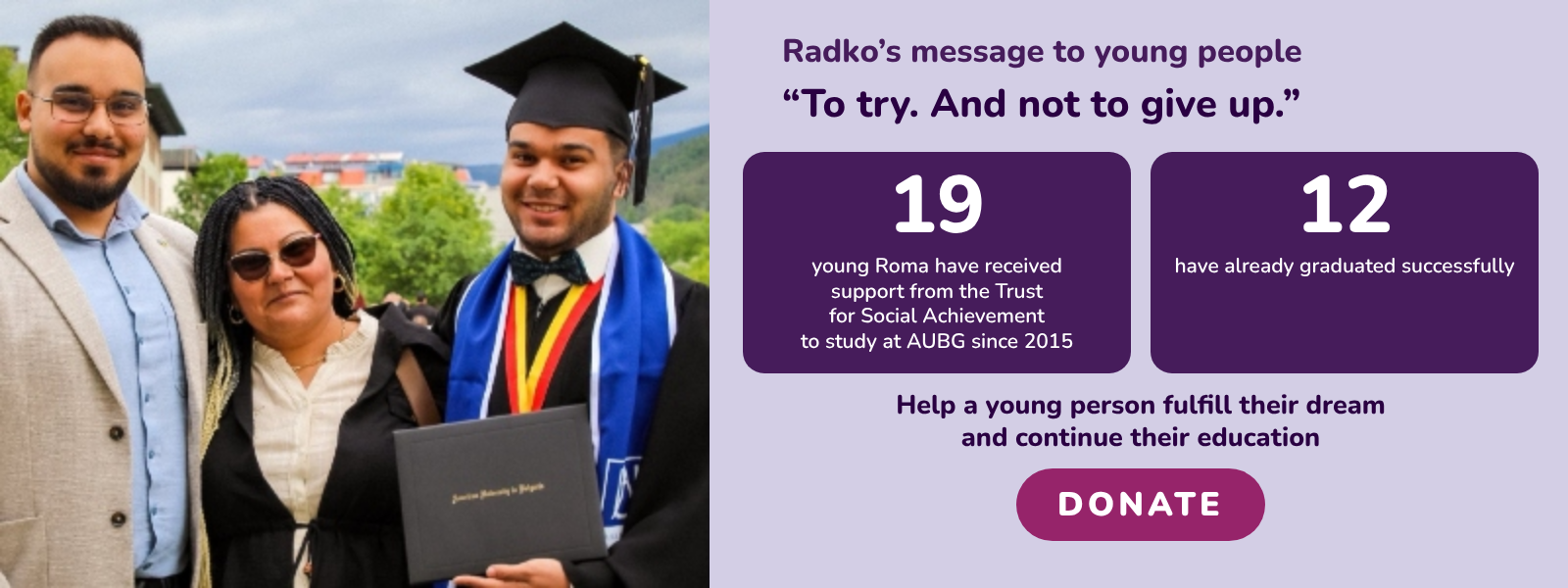
The cost no one sees
Behind the degree and the job at an international company are nights he worked until four in the morning because he had to study during the day. Radko juggled studying, work and student initiatives, something most of his classmates did not have to do. In his final year, he reached a point where he had gone about four days with almost no sleep. On a friend’s advice, he saw the university psychologist, and after about a month he was feeling better.
In his view, there are obstacles on the road to success that you cannot overcome alone, without support from friends, family and other people.
A scholarship as access to opportunity
“If I hadn’t received that scholarship, I absolutely would not have been able to study at the American University,” Radko says. For him, it meant more than money for education: it gave him access to opportunities he otherwise would never have had.
To those who say everything comes down to personal will, he answers: “Yes and no. Everything is a matter of will, up to a point.” Timing matters too, as do the people you meet and whether you even find out that an opportunity exists.
Four years that changed how he sees the world
Radko chose AUBG over a fairly clear path in cybersecurity in Varna because he wanted to see what other possibilities existed. He arrived at university as a rather closed person, focused mostly on computers. He left with an interest in politics, social inequality, international law and human rights.
For all four years he served on the Student Council and represented students on the Board of Trustees. There he learned that decisions in a large organization are not made in a vacuum, and he advises every student to take part in student government at least once.
Prejudice and the right to be yourself
Radko believes many Bulgarian students have a deeply mistaken picture of Roma life. When such conversations come up, he explains that many Roma work and study, and that the environment a person grows up in matters enormously. He has not personally faced discrimination at AUBG. What matters to him is that when Nazi and racist symbols appeared at the university, the institution responded.
In the IT sector he has not faced discrimination when applying for jobs, but everyday conversation still includes jokes about race or sexual orientation. International companies regularly ask employees whether they can be themselves at work, and managers discuss the results. “That’s why I think it’s very important for people to be able to be themselves at work.”
From computer science to human rights
Radko’s academic paper on Artsakh (Nagorno-Karabakh), forced displacement and the limits of international law received a university award. He saw a problem in how hard it is to prove genocidal intent. He proposed a framework for tracking signs and actions that signal risk before it is too late.
The research taught him that having international law, conventions, court rulings and institutions doesn’t automatically mean they work.
The responsibility of engineers
Radko believes people who build technology have a personal responsibility to think about how it might be used and whether it could cause harm. His example is Flock Safety cameras in the United States, which continuously read license plates and make it possible to track where vehicles move. He also describes cases where police officers used such systems to follow people for personal reasons.
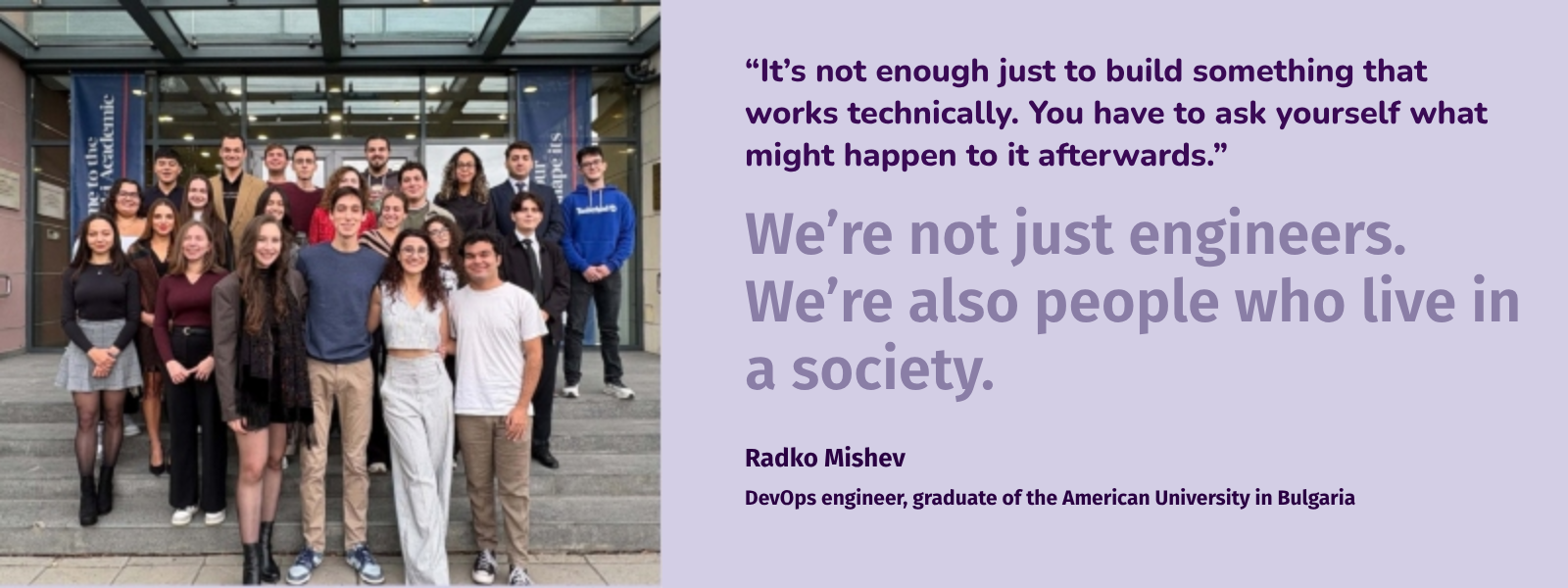
A message to young people
Radko would like one day to support other young people financially, the way he was supported. His brother played a big role in his path: he encouraged Radko to apply to AUBG and connected him with TSA. His message to young people: