

I try to carry the classroom with me into every Board discussion
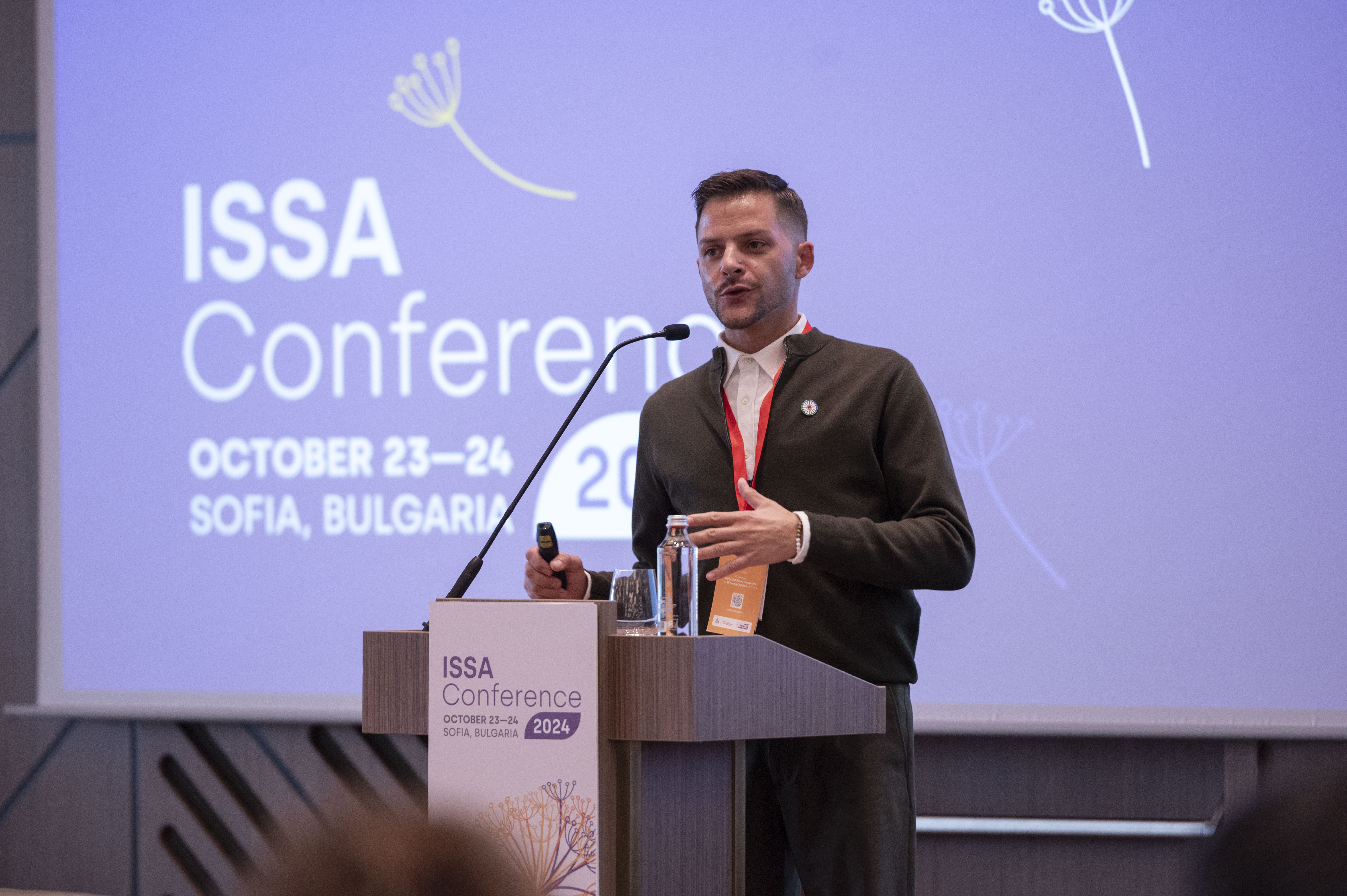
Aljoša Rudaš is an early childhood specialist of Roma background, with more than fifteen years working on inclusive education across Europe. He is Program Manager at International Child Development Initiatives (ICDI), serves as an expert for the Council of Europe, and, as a consultant, supports European civil society. He began his career as a preschool educator in Slovenia, in the same kindergarten he had attended as a child. He holds a Master's in Child Development. Aljoša is a member of our Board of Directors since the start of 2026.
When did you first learn about TSA, and what stood out to you at the time?
I first came across TSA in 2019, when I began my international career at ISSA, the International Step by Step Association. I was coordinating REYN, the Romani Early Years Network, which at the time brought together eleven national networks across Europe. TSA was, and still is, the home of REYN Bulgaria.
I remember meeting the TSA colleagues who coordinated REYN Bulgaria, Ivan, Silvia and Eugenia, during our first meeting in Leiden. One moment stays with me. We were filming a short video together about why diversity counts, with very little time to spare, and just as we started recording, the church bells began to ring, and kept ringing, as if they had something to say too. We laughed, waited, tried again, and somehow got it done. Looking back, it was a small preview of what working with TSA would be like: a shared message worth saying, a team that doesn't give up when things don't go to plan, and a good sense of humor along the way.
You can watch the video here:
Over the following years, we worked closely together on programs for young Roma children and on quality and inclusion in early childhood. What stood out to me from the start was how seriously TSA took the long view. They were not interested in quick visibility, but in building something that would last: a community of professionals who believed that Roma children deserve the same quality of care and education as any other child.
I watched REYN Bulgaria grow from a promising initiative into a network that drew the attention of hundreds of professionals, people curious to learn, to share, and to find better ways of serving young Roma children and their families. For me, that was the clearest sign of what TSA does well. It doesn't only deliver programs. It creates the conditions for people to come together, grow, and carry the work forward themselves.
You have seen this work in many countries, but your own experience of it started in your community in Slovenia. What carries across, and what is different here in Bulgaria?
What changes from country to country is the context: history, culture, politics, the way each society has chosen to deal with its past. What does not change are the needs. A child in Pušča and a child in Fakulteta need the same things: to be safe, to be loved, to learn, and to be seen as someone with potential and future. The same is true for their families and for the professionals who work with them. The real difference lies in how we respond to those needs, as individuals, as institutions, and as societies.
And there is one pattern that crosses every border I have worked across: the persistent discrimination against Roma. Let me be clear about this. If today Roma communities still face barriers to quality education, healthcare, stable employment, decent housing, political participation, and sometimes even basic legal documents, it is not because we did not want these things. It is not because we did not want to learn or to work, as public discourse too often suggests. It is because, at some point in history, someone decided that Roma did not deserve them. That decision was passed down through generations, built into systems, and normalized. And so, in the twenty-first century, we are still asking for something that should never have been in question: a place under the same sun, to grow and to thrive as equals.
What gives Bulgaria its particular strength, in my eyes, is the depth of the work that has already been built here. I see a generation of Roma professionals stepping into classrooms, nurses, medical doctors, lawyers, and a civil society that refuses to give up, and initiatives like Teacher in My Community that are changing not only who teaches, but who children believe they can become. The challenges here are real, but so is the momentum. And momentum, when it is supported and sustained, is how exclusion that took centuries to build can begin to be undone.
What made you want a seat on the Board?
Because I believe in investment, not in the financial sense alone, but in the decision to invest in people others have overlooked. Change for Roma communities has never come from quick fixes. It comes when someone commits for the long term, trusts people's potential, and stays long enough to see it grow.
That is what TSA does, and what drew me to it. It doesn't just run projects; it builds people, institutions and networks that remain after the funding ends. I have watched this for years through REYN Bulgaria and our shared work in early childhood, and I have always admired how TSA holds two things together: deep roots in communities and the ambition to change systems.
I am myself the result of such an investment. Someone once believed Roma children in my village deserved a kindergarten, and that belief shaped my family for three generations. Joining the Board is my way of giving back some of what was given to me. I bring the perspective of someone who has stood in the classroom, who comes from the community, and who has worked across many European countries. If I can help TSA carry its work and its voice further, beyond Bulgaria's borders and into the places where decisions about Roma children are made, then I will have done my part.
You have spent your career working directly with children, families, and teachers. Now you sit on the board of an organization that funds and shapes that work. What can you see from here that you could not see on the ground?
On the ground, you see the child in front of you. You see the family that trusts you, the colleague who needs support, the small victories and the daily struggles. It is the most honest place to be, because nothing there is abstract.
From the Board, I see the whole picture. I see how a single teacher in a classroom depends on decisions made far away: on funding that arrives on time, on partnerships built over years, on policies that open or close doors. I see how much patient, invisible work stands behind every success story, and how fragile that success can be if the system around it doesn't hold.
One thing I understand much better now is the importance of stable, long-term funding. The world keeps changing, and so do the priorities of those who fund social change. New crises emerge, new agendas take shape, and resources naturally follow them. That is understandable, and often necessary. But it creates a real tension for early childhood. The benefits of investing in the youngest children are among the greatest of all, yet they take the longest to become visible: in school completion, in employment, in healthier and more cohesive communities, often twenty years later. When budgets tighten and results are needed quickly, early childhood is too often the first place where cuts are made, precisely because its impact cannot yet be measured in the short term. And so the youngest end up carrying the weight of decisions they had no part in.
This is why I value TSA's role so much. It helps hold a steady line when priorities shift around it, and it works with partners, donors and institutions to keep the long view in sight. Change for Roma communities is a generational journey, and it needs companions who are willing to walk it for a generation.
I also see connections I couldn't see before. A training program in one town, a network of professionals in another, a conversation with a ministry in Sofia: from here, they are not separate pieces but parts of one ecosystem. Change happens when those pieces are anchored in communities and linked together strongly enough to shift the system.
But the view from here comes with a responsibility. Distance can make you forget the faces. So I try to carry the classroom with me into every Board discussion, and to keep asking one simple question: what will this mean for the child, for a family, and community?
Which of TSA's program areas speaks to you most?
Early childhood, and I can tell you exactly why. The kindergarten where I first learned to hold a pencil opened in 1962, in Pušča, the largest and oldest Roma settlement in Slovenia. It was the first kindergarten built specifically for a Roma community in the former Yugoslavia. My father attended it. My sister attended it. Years later, so did I. And after I graduated from university, I came back, this time carrying the teacher's keys instead of a toy. I remember standing at the classroom door before the children arrived, thinking how small all the furniture looked now. Then I noticed the children were watching me the way I had once watched my own teachers, except they knew me, from the village, from the street where I live. That moment taught me something I only later found the words for.
It also taught me why the early years matter so much. This is where children first learn who they are and who they can become, and it is where every investment lasts the longest.
What is one thing you wish more people knew about the communities TSA works with?
That the potential has always been there. What has often been missing is the example.
I've stopped saying representation matters, true as that is. I say something more precise now. Representation is not about visibility. It is about permission. Children borrow permission to dream from the adults they see around them. For generations, many Roma children absorbed the opposite message: people like us don't become teachers, don't study, don't belong there. A teacher from the community doesn't argue against that belief. Their existence disproves it.
What gives you hope?
The ripple. The Teacher in My Community program has supported more than a hundred people, most of Roma origin, to become qualified early childhood teachers in their own neighborhoods. The large majority of those who finished found work in education, so there are now close to thirty teachers, and counting, standing in classrooms. None of them works alone. Each one stands beside a room full of colleagues every day, which adds up to over a thousand education professionals working alongside a Roma colleague. Those people go home and talk to their families and neighbors. One conversation at a time, prejudice that is centuries old starts to lose its grip. And it reaches the children too, thousands of them, many not Roma at all, who simply grow up knowing that a Roma person can be a teacher. Now imagine not a hundred teachers, but a thousand. That is how societies change. Not through slogans, but through repeated human encounters and interactions.
And it is why patience and long-term commitment matter. A ripple takes time to reach the shore, but when it does, it changes the whole landscape.
How do you envision Bulgaria's future if TSA's mission succeeds?
I imagine a Bulgaria where a child's future is no longer predictable from the street they were born on.
If TSA's mission succeeds, a Roma child will begin life with the same foundations as any other child: a healthy start, clean water at home, a parent who has support in those first fragile years, and a place in a good kindergarten. That child will move through school without being pushed to the margins, and will have real chances to finish, to go further, and to choose a path. Their parents will have stable work, secure homes, and the documents and rights that make them full citizens, not guests in their own country.
But the change I hope for goes beyond statistics. I imagine classrooms, hospitals, municipalities and courtrooms where Roma professionals are simply part of the picture, not the exception people talk about. I imagine children, Roma and non-Roma alike, growing up without ever questioning who can be a teacher, a doctor or a mayor. And I imagine communities that are no longer described only by what they lack, but by what they contribute.
That is when we will know the cycle of poverty has been broken: not when Roma are finally included, but when nobody remembers why they were ever excluded. And a Bulgaria that makes room for everyone's potential is not only fairer. It is stronger, for all of us.
What do you do outside your role with TSA?
Most of my working life today is at International Child Development Initiatives (ICDI) in the Netherlands, where I am surrounded by an amazing team of colleagues from around the world. I manage programs on early childhood, inclusion, democratic citizenship, online safety and dropout prevention. A big part of my work is supporting teachers and professionals across Europe and beyond by creating tailored tools and solutions that help them turn big words like participation and inclusion into everyday practice with children. I also serve as an expert to the Council of Europe on education for democratic citizenship in early childhood, and I am part of several networks that bring experts together across borders. The thread running through all of it is simple: children are not citizens of tomorrow; they are citizens today, and democracy begins in the way we treat them in the smallest moments, from the very start of their lives.
Outside work, I try to slow down. I am inspired by the principles of slow pedagogy, the idea that children, and adults too, learn and grow best when we give them time, rather than rushing from one goal to the next. And I carry with me the spirit of Ubuntu, the Southern African philosophy often summed up as "I am because we are": the belief that we become who we are through our relationships with others. Both remind me that the most important things in life cannot be hurried and cannot be done alone.
I love hiking and spending time in nature, and living in the Netherlands has, of course, turned me into a big fan of cycling. My favorite route is after a long working day: cycling to the seaside for a short stroll along the shore, hoping to spot a seal, and ending with a cup of tea and a slice of apple pie.
I also love photography. I like to capture moments and experiences, just as I used to when I was a kindergarten teacher documenting children's learning. Apparently, some professional habits never leave you; they simply become part of how you see the world.
And whenever I can, I take to the road. I love road trips and finding hidden places that most people pass by, and wherever I go, I always carry a piece of Pušča and Slovenia with me.