

The Healthy Baby, Healthy Future Foundation will continue implementing the Nurse-Family Partnership model until the service is taken over by the state.
Since July, Sofia Municipality has been funding a new Community Centre for Children and Families – a mobile social service for vulnerable pregnant women, young mothers and families with young children. The centre is managed by the Healthy Baby, Healthy Future Foundation, established in 2024 to ensure the sustainability of the international Nurse-Family Partnership (NFP) model in Bulgaria.
The contract was awarded following a competition launched by the municipality. It is valid until the end of 2027, but may end earlier if the service is included among the social activities financed by the state.
Until then, the costs will be covered by Sofia’s municipal budget. The maximum monthly funding is €11,000, and the service has a capacity of 30 users. Support is provided primarily through home visits. The team includes nurses and midwives, health mediators, a social worker, a psychologist and a programme manager.
The decision to establish the service was adopted by the Sofia Municipal Council in February. It ensures the continuation of work that had previously depended largely on project-based and donor funding.
Support from Pregnancy to the Child’s Second Birthday
Nurse-Family Partnership is a model designed for young women expecting their first child who live in poverty or face other significant challenges.
Globally, NFP is among the most extensively researched early childhood programmes. The model is supported by decades of research and long-term follow-up of participating families, with positive effects on some indicators continuing to be observed years after the home visits have ended.
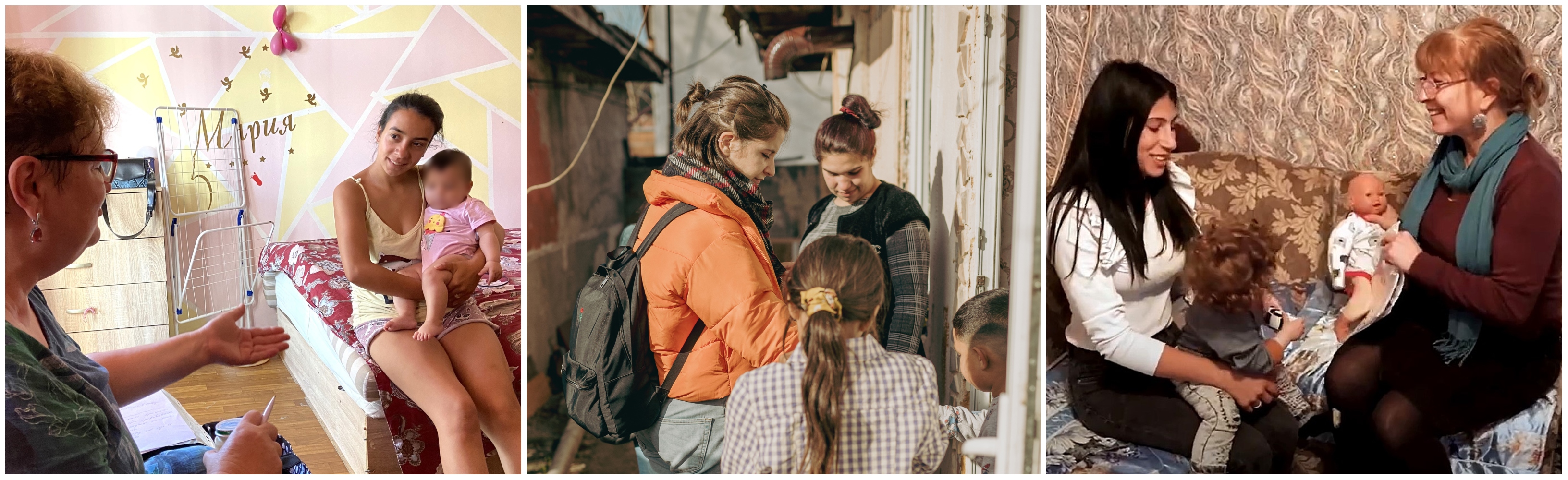
In Bulgaria, the programme was introduced by the Trust for Social Achievement in 2016 under the name “Together – Healthy Baby, Healthy Future”. An evaluation by Utrecht University involving more than 700 mothers found positive results in parenting skills, feeding and breastfeeding, as well as significantly better indicators of early child development among participating children.
How Families Access the Service
The primary target group remains women aged up to 22, who can enrol during pregnancy and take part in the full programme cycle.
The service will also accept families referred by Child Protection Departments. In these cases, the mother may already have given birth. The family can join at the relevant stage of the programme rather than remaining without support simply because it was not identified early enough.
This is an important possibility in the Bulgarian context. The country does not have an established mechanism through which vulnerable pregnant women can be systematically identified and referred to such a service.
In practice, the early inclusion of pregnant women depends to a large extent on the fieldwork of health mediators and the trust that teams have built in the neighbourhoods and communities where the service operates. Within close-knit communities, this is possible, although challenging. Outside them, a young woman at risk may remain invisible to health and social services until childbirth or until a serious problem emerges.
Referrals from Child Protection Departments therefore do not change the essence of NFP. They provide an additional entry point to the service for families that the system has not managed to reach during pregnancy.
What Sofia Municipality Is Taking On
Municipalities in Bulgaria can finance social services using their own resources, and Sofia is not the first municipality to do so. What is more significant in this case is precisely what the municipality is taking on.
Rather than creating another short-term programme, Sofia is ensuring the continuation of an already established model, a trained team and long-term work with families. This preserves the accumulated experience while sustainable national funding is being developed.
This transition did not happen in Plovdiv. There, the same programme operated until the end of 2025 but was discontinued due to a lack of funding. Around 50 families were left without specialised support, while the team that had worked with more than 200 families over seven years was disbanded.
As a result, Sofia remains the only one of the two cities where the programme was implemented to have secured local public funding for its continuation.
Why Home Visits Cannot Be Replaced by Office-Based Consultations
Home-based work is a core component of the model, rather than simply a convenient way of conducting meetings.
At home, the nurse can see how the child is being fed and cared for, whether there is a safe place for the child to sleep, how the mother recognises the child’s cues, and who is involved in everyday care.
It is also where issues that are difficult to identify during a one-off institutional meeting may become visible – lack of food, violence, social isolation, an unsafe home environment or the family’s inability to access a doctor.
Home visits allow the support to evolve as the child develops. During pregnancy, the focus is on the woman’s health and preparation for childbirth. After that come feeding, breastfeeding, attachment, safety, development and parenting skills.
The family nurse does not replace the GP, obstetrician-gynaecologist or social worker. Instead, she helps the family reach them and follows up to ensure that the necessary support has actually been received.
A National Model, but Not Yet National Coverage
Sofia’s decision comes at a time when the state has also announced plans to expand patronage care. In May, the caretaker government approved a national model for pregnant women and families with children up to the age of two. It is intended to be implemented through health counselling centres for maternal and child health in all regions of the country.
The model includes three levels of support – universal, progressive and highly targeted – depending on identified health and social risks. €1 million has been allocated for its launch in 2026.

However, the announced annual coverage is 6% of the target population. This means that while the model is national in terms of its organisational structure, it is still far from being a service accessible to all pregnant women and families with young children.
Three months after the decision, practical implementation is still pending. It remains unclear how the funding will be distributed among the individual centres, when the teams will begin work, and how many families will be reached by the end of the year. Given the delay, even reaching the planned 6% may now be uncertain.
There is also a longer-term limitation. Patronage care is delivered by nurses and midwives, while Bulgaria faces a serious shortage of professionals in both occupations.
The number of nurses is declining, a significant proportion are approaching or have already reached retirement age, and their distribution across the country is uneven. There is also a shortage of specialists with specific training in home-based work.
For this reason, the expansion of the national model cannot happen simultaneously across the entire country. In addition to funding, it will require people, training, supervision, team management and a mechanism through which families can actually be identified and enrolled.
A Local Solution Before National Expansion
The municipal service in Sofia will not solve the shortage of patronage care across Bulgaria. Its capacity is limited to 30 users and it is aimed at families with the greatest need for support.
The decision does, however, preserve an existing team and allow the NFP model to continue while the national model is still building its own capacity.
The next question is when the state will take over the funding and whether the planned standard will be sufficient to maintain the intensity of home visits, the specialised training of nurses and midwives, and regular supervision.