

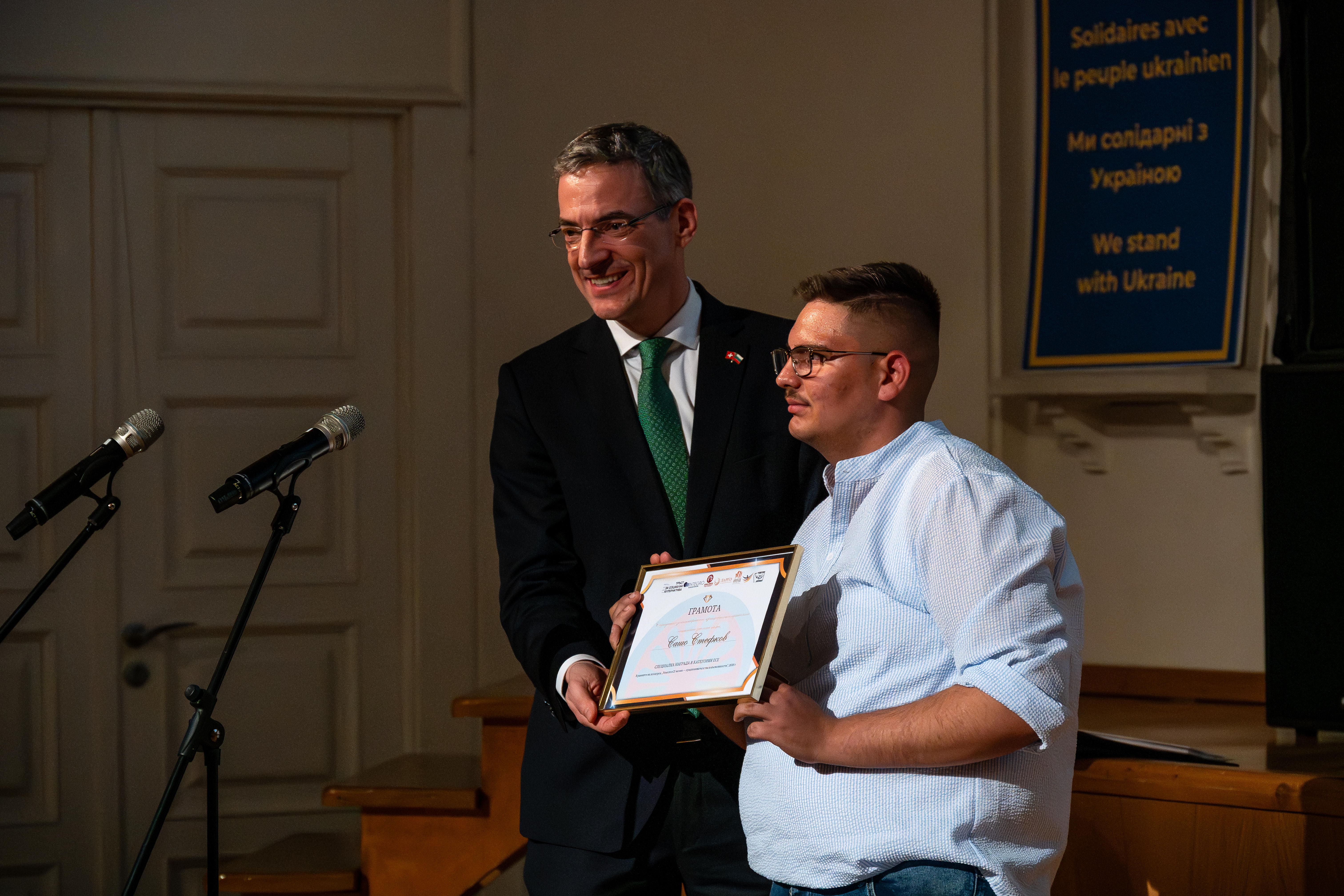
The essay “Bulgaria in 2026: Outrages or Flowers and Roses” by Sasho Stefkov received the special award. Sasho’s award was presented by the Ambassador of Switzerland to Bulgaria, H.E. Pierre Hagmann.
My town is small, but it is full of big dreams. Here, hope and disappointment exist side by side, and the future depends on us—the young people. It depends on whether we choose education or give up on our dreams.
I live in a small town filled with dreams, but also with a lot of ruin. When I think about what Bulgaria looks like in 2026, I see both flowers and roses, but also many harsh realities. The truth lies somewhere in between.
In my school, there are many Roma children. Among them are talented and ambitious young people with goals, ideas, and dreams. They want to study so they can have good jobs, build good families, and have a better future. They want to live better than previous generations. These are the children who inspire me the most. I always try to encourage them not to give up and to do everything with dedication. I feel happy when I see them thinking about their future and striving to become something more.
But there is another side as well. There are young people who have stopped dreaming. Some of them do not have support from their parents. There are children who suffer because of family problems—separated parents or lack of attention. Some even believe that education is useless. This is a sad part of our reality.
One of the serious problems in the Roma community, especially in smaller towns, is early marriage, although in our town this is already becoming less common. It is not unusual to see children having children. As a result, many young girls and boys interrupt their education and begin a difficult life without enough preparation. Instead of focusing on school and personal development, they face responsibilities they are not yet ready for. In my opinion, this is a major obstacle to the development of both the community and the country.
At the same time, I see positive change. More and more young Roma people are choosing to continue their education, complete secondary school, and even pursue higher education. They become role models for younger children and show that with determination and ambition, it is possible to overcome difficulties. There are also various programs and initiatives that give young people opportunities to grow and develop.
When we see successful Roma individuals who have become well known in Bulgaria, they do not only change their own lives—they also change the way society views the Roma community.
I cannot fail to mention discrimination. There are still stereotypes about Roma people, and young people sometimes find it difficult to get a job, especially if they lack education. However, I believe things are improving. Today, more and more Roma people are working, studying, and proving themselves. I believe that if we show that we are responsible, talented, and hardworking, discrimination will continue to decrease.
When we, as young people, study, develop our talents, and take part in school and community initiatives, we not only preserve and pass on our culture and language, but also influence Bulgaria and even the wider world. We show that education and hard work can bring real change.
In Roma culture, people in almost every town speak the Roma language, even though there are different dialects. The words may sound different, but we understand each other because the language connects us. We love music and express our emotions through its many styles. In recent years, some traditions have changed, such as the practice of paying a bride price and other old customs. We, the younger generation, choose our own path. We place family first, show deep respect to our parents, honor the elderly, and maintain strong bonds with one another.
Our faith is also very important to us - we are Evangelical Christians and believe in God regardless of our age. We have youth ministries and observe religious traditions and holidays. We are people with kind hearts. We are always ready to help, no matter who the person is or what their background may be. If someone is in need and we can help, we will. We welcome people into our homes and would never let a guest leave hungry - we will always share what we have. We do not judge people by their ethnicity, religion, or differences, but by their humanity. What matters to us is whether a person is good or not. Good people show kindness, respect, and compassion, while those who do wrong reveal it through their actions.
National, political, and global processes - such as poverty, elections, wars, and economic crises—directly affect our lives and our community. They create difficulties and uncertainty about the future. These challenges affect all of Bulgaria: prices are rising, and the job market is becoming more limited. For many Roma families, who often have lower incomes due to limited job opportunities and lack of education, this means fewer resources for their children - for school materials, clothes, and basic needs.
I want to see Bulgaria become a more educated and just country—a country without early marriages, where young people have equal opportunities and the right to express their opinions. I want more children to believe in their dreams, and I will always support those who want to learn and grow. I believe that when one person succeeds, they become an example for many others. I choose to believe in goodness and in the power of young people, because it depends on us whether Bulgaria will become a fairer and brighter country.